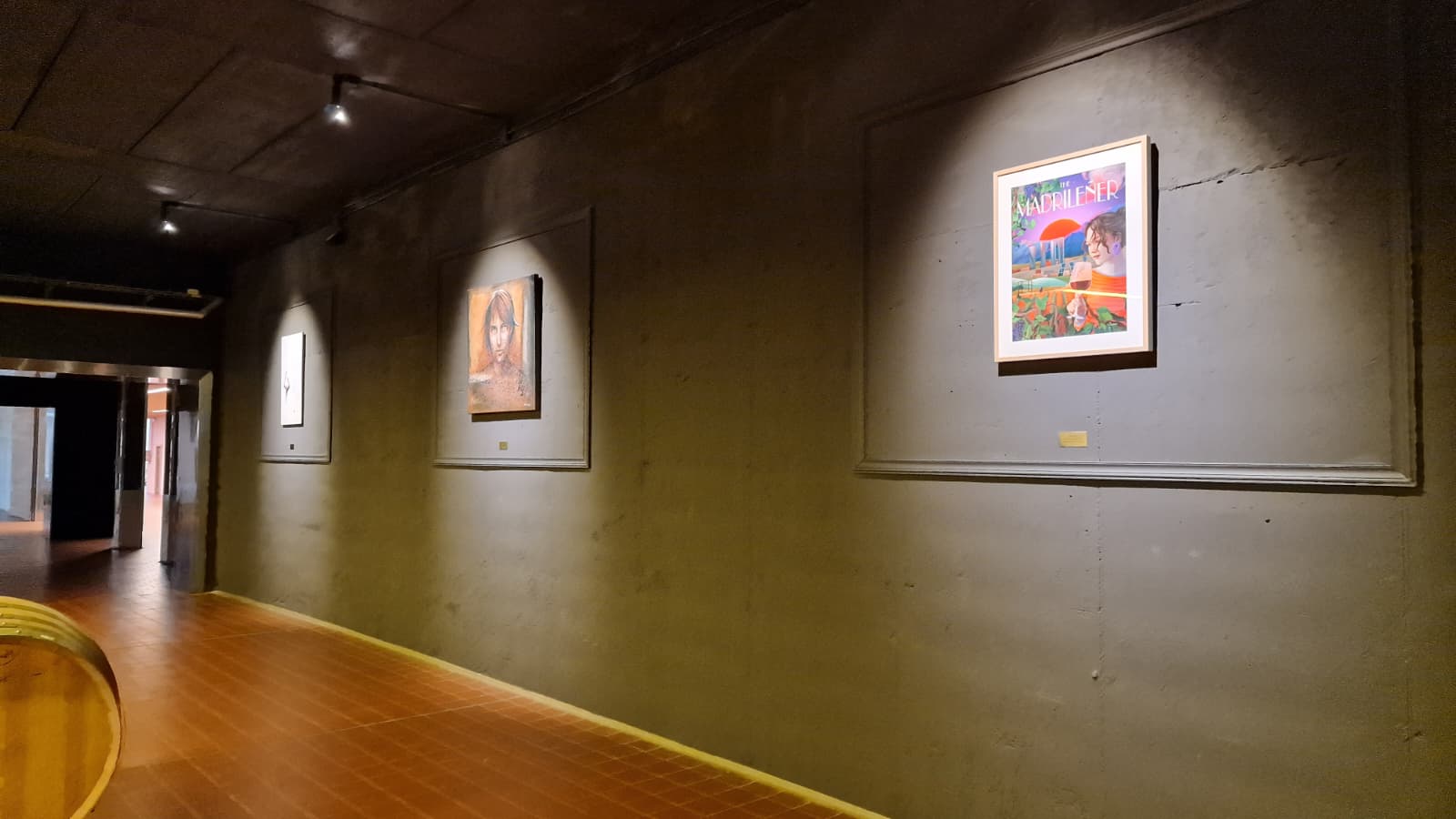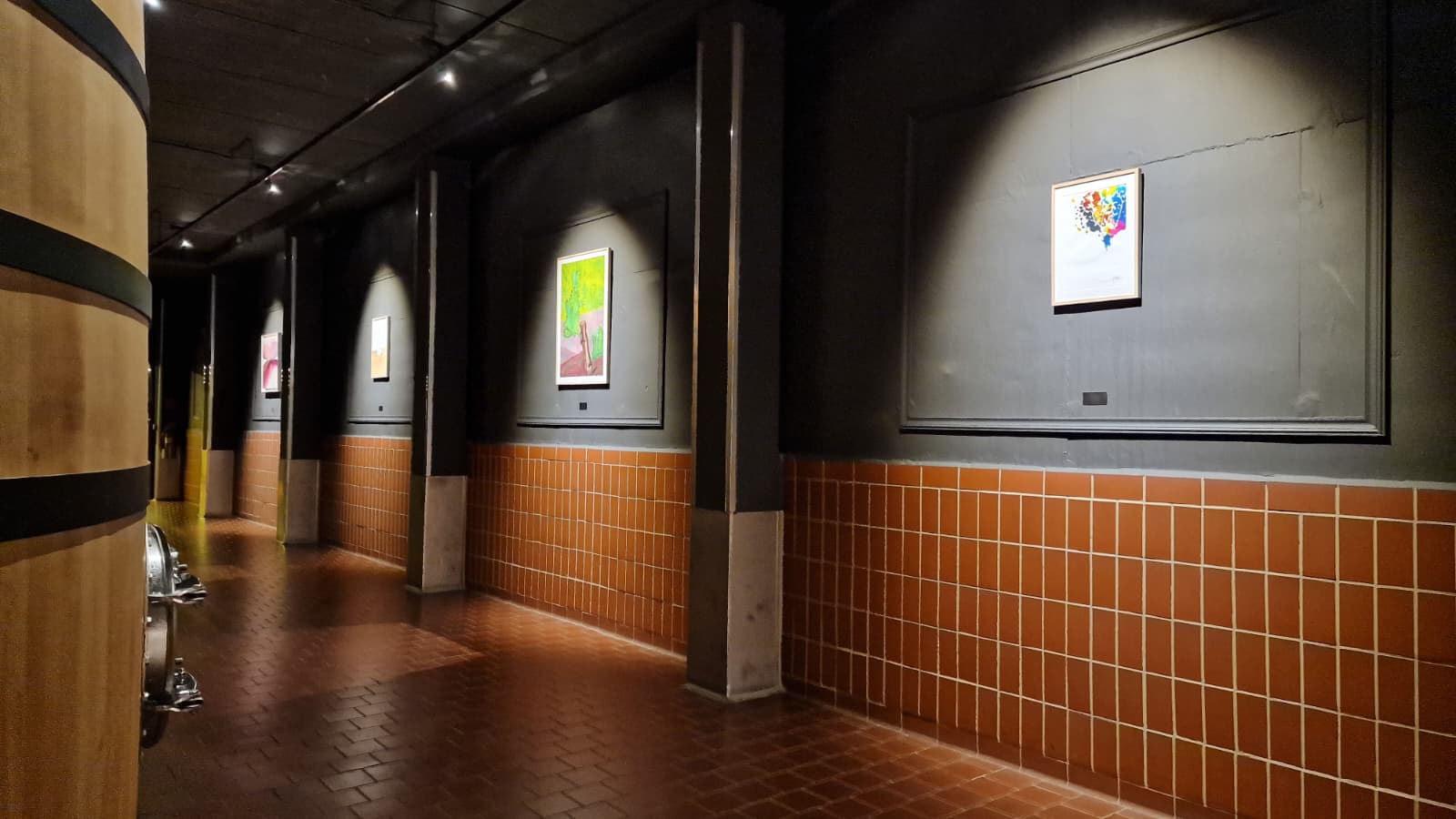

In 2020, we set out, full of enthusiasm, on a journey whose destination we did not yet know. Back in those pre-Covid days, we wanted to enrich our perception of the landscape around us through the interpretations of various local artists, who would bring colour, lines and shapes to their vision of the surroundings. The premise was simple: ‘We want a work of art that interprets spring in this area.’ Visual art has served, and continues to serve, as a way for us to celebrate each new cycle with you. The arrival of spring, the budding of the vines and the start of a new wine-growing year mark the beginning of many feelings, fears and hopes. The experience of the previous year and earlier cycles provides a degree of security, but the changing reality of the climate and the increase in adversity mean that, with six projects in north-western Spain, the risks are not divided but multiply exponentially. Yet life, once again, finds a way. The buds are sprouting and there is urgent work to be done. And that feeling, far from being overwhelming, is wonderful. That is why, with every new spring, we want to remember the people who stand by our side and who give us so much to keep us moving forward.
In 2025, we completed the series of artworks depicting our local area: Peñafiel, Leza, San Martín de Valdeiglesias, Leiro, Nieva and Fuentenebro, in that order. A select group of local artists have helped us to understand, from different perspectives, what a new spring means in each of the landscapes in which we find ourselves: Laura Juárez, Raquel Marín, Jorge Thuillier, Jorge Alonso, Gustavo Fuentetaja, Nano Lázaro and Beatriz Ramo.
Today, art and landscape engage in a dialogue at our Pago de Carraovejas site, where visitors can admire this carefully curated collection of artworks linked to the regions where our projects originate, establishing a connection between landscape, culture and contemporary creation.
Land of Bacchus
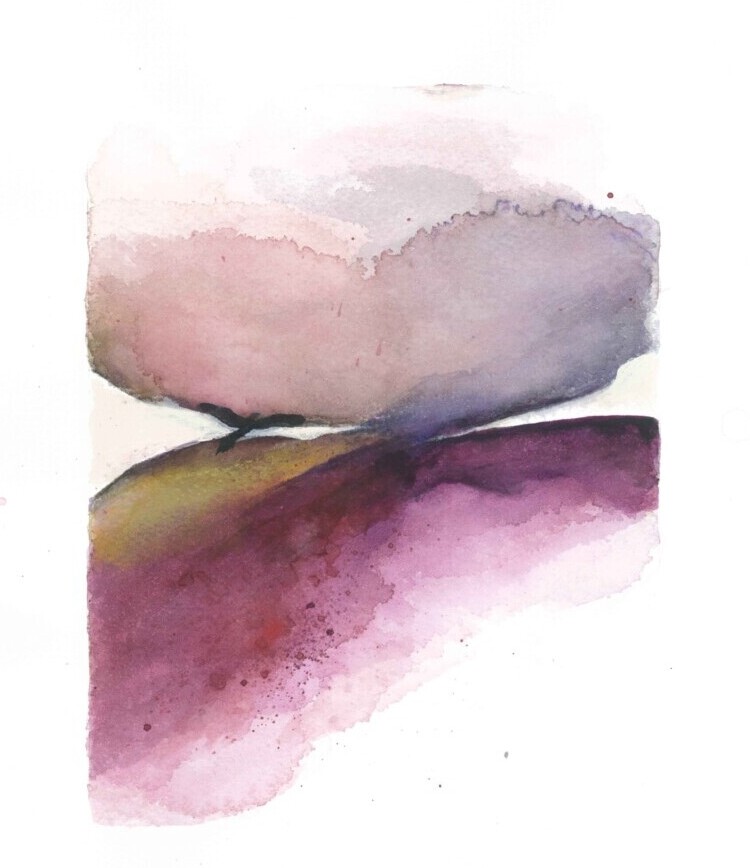
The first artwork was *Land of Bacchus*, created in 2020 by the Valladolid-based artist Laura Juárez, dedicated to Pago Carraovejas.
This artistic creation seeks to engage the viewer’s senses and evoke a synaesthetic experience: the opportunity to ‘taste’, through sight, a red, a white and a rosé wine. The work maintains an intimate connection with wine culture and the elements that surround it, creating a horizon where sky and earth meet. As the artist herself points out, the composition is built around a sky of rosy hues, a sunset over the Castilian countryside that evokes the poetic and the romantic. In the centre, a space of light criss-crossed by golden strokes symbolises white wine and lends a touch of magic and fantasy. The lower section, dominated by deep, velvety reds, represents the world of red wines through a broad palette of carmine, violet and magenta.
About the artist: Laura Juárez (Valladolid, 1982) holds a degree in Fine Arts from the University of Salamanca. Her work falls within the realm of abstract expressionism, understood as a space for exploration where subtlety, emotion and feeling are constructed through mixed media. Oil, waxes, graphite, cardboard, enamels and resins coexist across various formats and media, giving rise to a unique, material and deeply sensory language. Throughout her career, she has received numerous accolades, including the Luarca National Art Competition and the Autumn Salon. Currently, Laura Juárez continues to broaden her artistic vision from a small studio in the city of Valladolid. It is a space that allows her to return to her roots and focus on training, technique and skill, drawing on a conception of art based on restraint, sensitivity and a vision reserved for those who know how to pause and reflect.
The arrival of spring
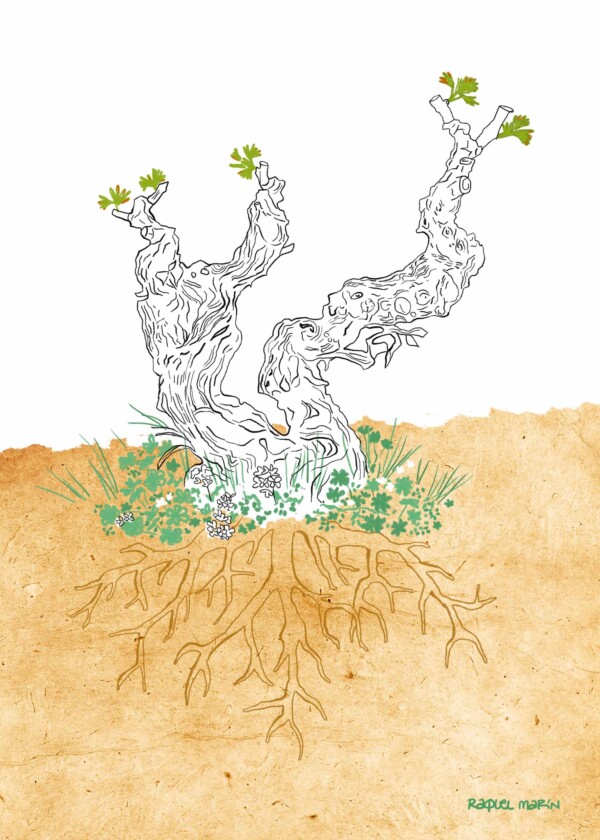
Raquel Marín is the illustrator and visual artist behind this work, in which she approaches this time of year as a period of transition and rebirth. The first shoots and wildflowers emerging in Leza form the central theme of a composition inspired by one of the oldest vines in the historic Aiurri vineyard in this town. The illustration invites a contemplative view of the landscape, where the plant life is expressed with naturalness and balance, evoking the latent energy of the start of a new cycle. The work establishes a direct dialogue between the culture of the vineyard and the idea of legacy. That ancient vine, now part of the project, is presented not as a possession, but as a shared responsibility: it is not an inheritance received, but a loan from those who are yet to come. Spring manifests itself as a symbol of continuity, care and respect for a landscape that transforms without losing its memory.
About the author: Raquel Marín is an illustrator and visual artist. Her work is characterised by a delicate and attentive gaze towards the land, detail and natural cycles, with a distinctive style that combines drawing, colour and a sensibility deeply rooted in the landscape. Taking a contemporary approach, her work explores the relationship between nature and time, emphasising that which grows silently and persistently.
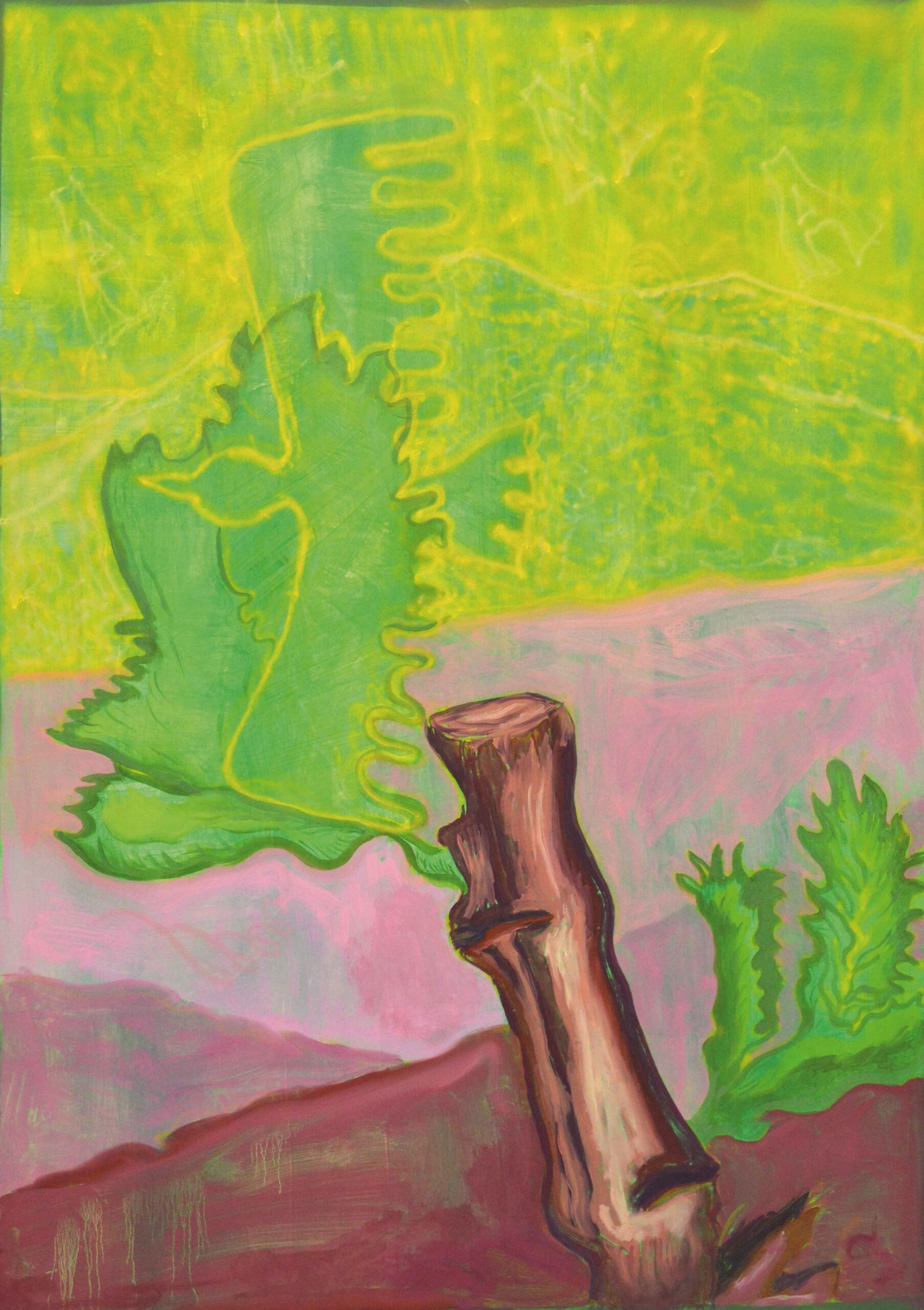
The creation of a new beauty in spring
Jorge Thuillier interprets the equinox as a moment of transformation and pent-up energy. The work places the viewer within the landscape of Marañones, in San Martín de Valdeiglesias, where the undulating terrain of the vineyard is rendered as ascending diagonal lines that lend the composition rhythm and vitality. A landscape in which the stillness of the beginning of a new cycle, in the foreground, coexists with the intense activity heralding the arrival of spring in the background. The shoot emerging from the vine frames the scene and blends with the landscape and the sky through various symbolic elements, including the eagle—an emblem of Alma Carraovejas’s philosophy—which soars above and accompanies the vineyard as an image of care, protection and the passing on of a legacy. Light forms the backbone of the entire composition: luminous yellows intermingling with vivid greens and a more subdued pink, a direct evocation of the pink granite found in some of the Marañones plots, the essential substrate of these unique vineyards. The chromatic balance harmonises both planes and gives rise to a luminous and deeply coherent work. In this oil painting, Thuillier pays tribute to the wine-growing culture of the Sierra de Gredos and to the wines of Madrid, capturing a fleeting moment brimming with vigour, freshness and energy, much like the very onset of spring itself.
About the author: Jorge Thuillier lives and works in Madrid. He holds a degree in Fine Arts from the Santa Isabel de Hungría University in Seville and is a qualified sommelier from the Madrid Chamber of Commerce; this dual perspective — artistic and oenological — flows naturally through all his work. He comes from a family with a long tradition linked to wine: the Thuilliers, of English origin, settled in El Puerto de Santa María in the 19th century to produce and sell wines, a legacy that remains very much alive in his understanding of wine culture
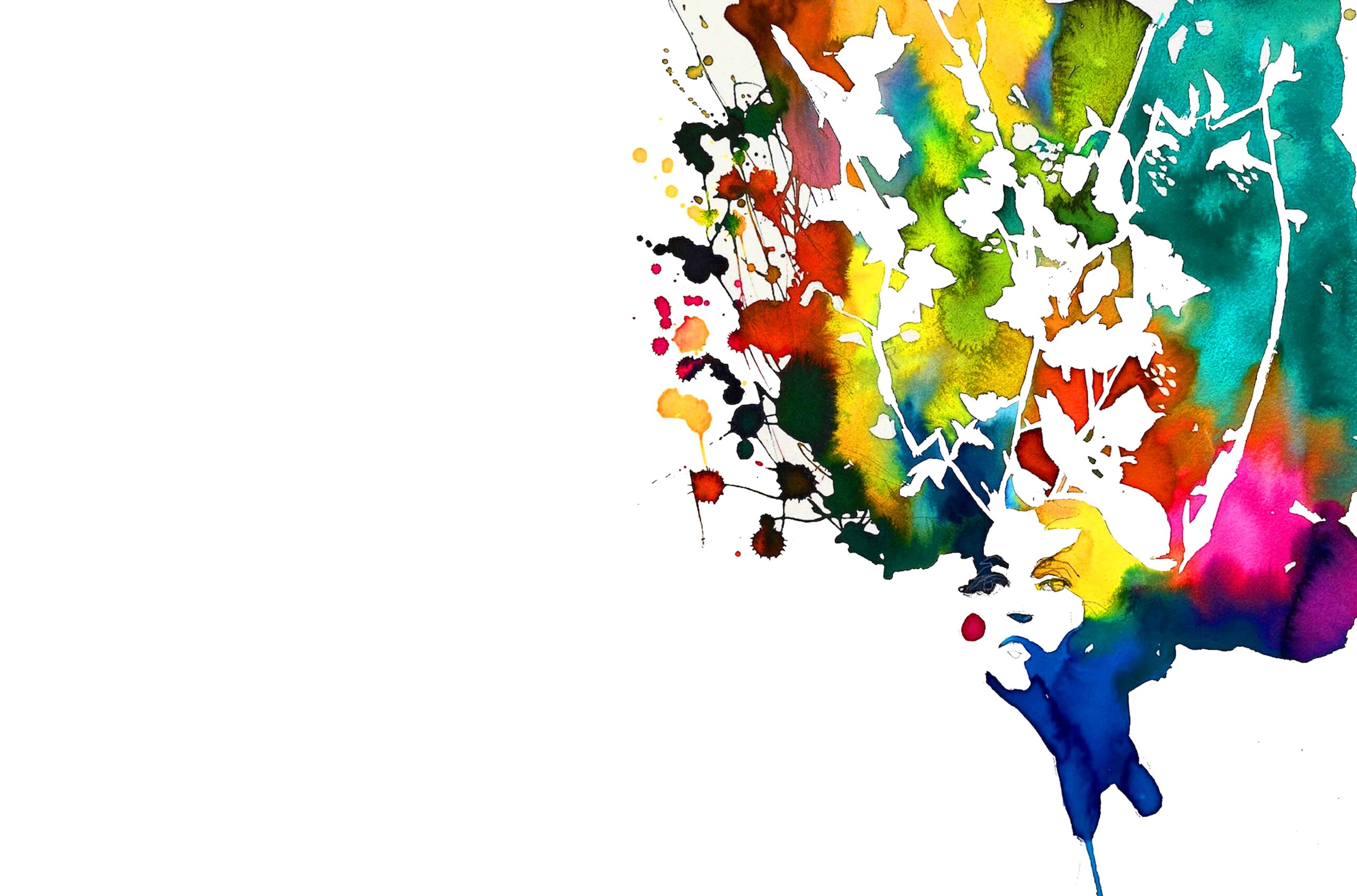
Spring Woman
In 2023, Jorge Alonso – a multi-talented artist who combines his work as an architect with a solid career as a painter and illustrator – presented his painting “Spring Woman”, which was inspired by two interlinked themes: the evocation of spring and its connection with wine. In this work, Jorge Alonso blends his personal style—recognisable by his distinctive way of drawing—with a visual exploration of both concepts. The composition arises from the union of two complementary ideas: on the one hand, the depiction of vine leaves and vine branches using an intense colour palette, verging on abstraction yet rooted in recognisable elements; on the other, the inclusion of a woman’s gaze as a figurative focal point capable of drawing the viewer in and endowing the work with a direct emotional dimension. The fusion of these two elements results in a balanced and vibrant piece, in which nature, colour and the human figure coexist as symbols of renewal, energy and vitality—values associated with both spring and the world of wine.
About the artist: Jorge Alonso (1975) is a multi-talented artist who combines his work as an architect with a solid career as a painter and illustrator. Having trained in architecture in Madrid, his experience in this discipline has enabled him to develop a broad and interdisciplinary perspective, which translates into an artistic practice open to multiple forms of expression: illustration, poster design, portraiture, drawing and the creation of everyday objects. His pictorial work centres on a constant fascination with the female figure, the intensity of colour and the expressive depth of the gaze. Influenced by Austrian Expressionism, Alonso pursues a direct, unpretentious sensuality, reinforced by the use of vivid colours that interact with the pencil strokes and emphasise the strength of the line.
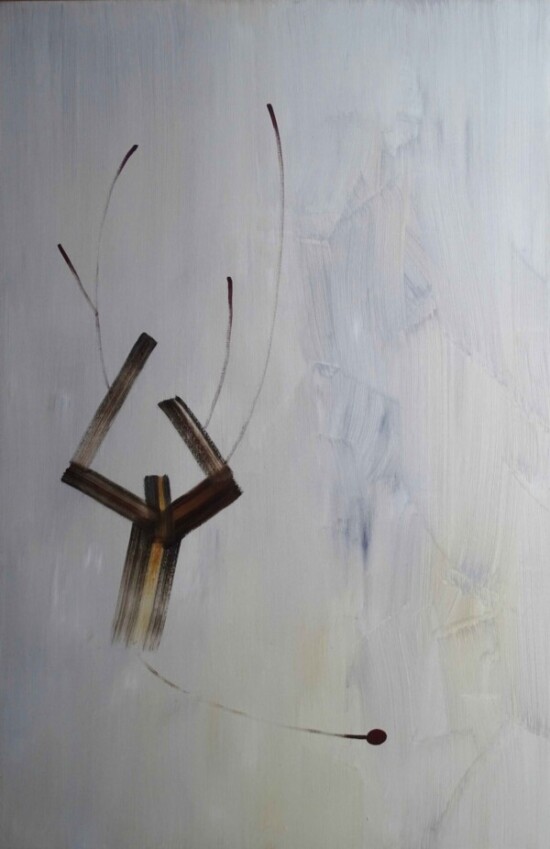
The Awakening
In ‘The Awakening’, Gustavo Fuentetaja explores one of the most subtle and decisive moments in the life cycle of the vine: the period just before budburst. The work captures that moment of contained tension through a direct, vivid and highly symbolic creation. The lines and colour schemes are arranged in a composition that gives clear prominence to the central element, enveloped by an atmosphere that complements and amplifies its presence. His painting seeks to transcend the purely visual. With just a few precise and profound brushstrokes, he constructs geometries and fields of colour that refer both to recognisable realities and to the intangible: sensations, emotions and moods. A work that invites leisurely contemplation and finds in the vine and its awakening a reflection of the natural processes that also give rise to wine.
About the artist: Gustavo Fuentetaja (Segovia, 1994) began painting in oils at the age of nine at a fine arts academy in his hometown. Since then, his career has been characterised by an early and consistent engagement with the language of painting, understood as a space for technical and emotional exploration. At the same time, he has developed a deep connection with the world of wine, which has led him to study viticulture manuals in order to understand the biological cycle of the vine, grape varieties and the influence of geological and climatic factors on the vineyard. In 2019, he presented the series ‘Los veinte óleos’ (The Twenty Oil Paintings), a collection of abstract works exhibited at the Backyard gallery in Simancas, which marked a turning point in his career and paved the way for various solo and group exhibitions both nationally and internationally.
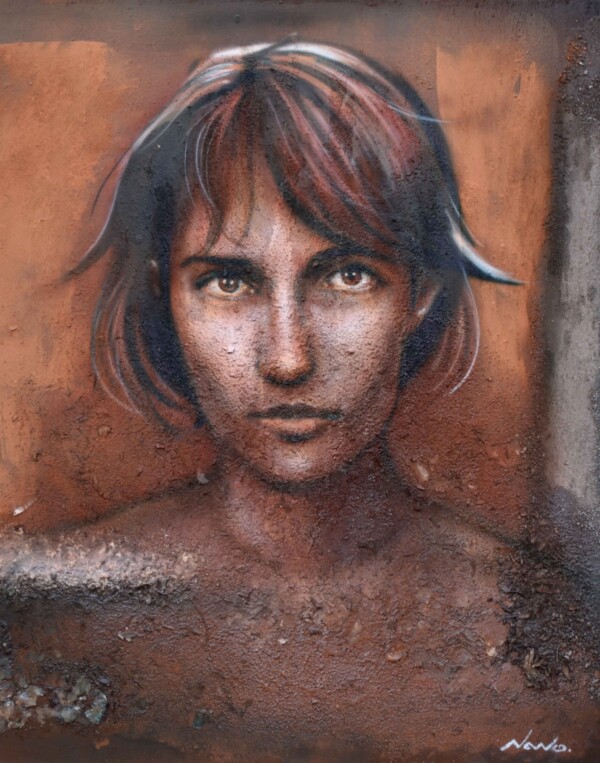
Layers of the Soul
The latest work was created by Nazo Lázaro, a painter and muralist, who in this piece establishes a profound dialogue with the vineyard. Red sands, minerals such as mica, feldspar and white quartz, alongside fragments of wood from old vines, are integrated into the composition, lending it a physical and sensory dimension that transcends the visual. The materials refer directly to the wine-growing landscape of Fuentenebro, its geology and the memory held within its soils. The figure of a serene and composed young woman introduces a human and symbolic counterpoint. Her presence evokes freshness, vitality and fragility, in contrast to the solidity of the ground that supports her. As with Milsetentayseis, each vintage captures a unique moment born of millennia-old soil; the work reflects that same dialogue between the ephemeral and the permanent, between fleeting time and the depth of origin. More than a painting, ‘Estratos de Alma’ is a material experience that invites the viewer to observe it from a different perspective. A work that speaks of strata, of memory and of place, and which, like a great wine, tells the story of the territory from which it comes. With this creation, Nano Lázaro brings the majuelo into everyday life and elevates it to the status of art.
About the artist: Nano Lázaro (1979) is a painter and muralist. With roots in Segovia and a career spanning Valladolid, Burgos and Aranda de Duero, his work is deeply connected to the Meseta and an intimate understanding of the region. This understanding is built on direct experience, attuned to the colours, textures and layers that make up the landscape. From a very early age, it was clear to him that painting must stem from the material itself, understood not merely as a medium, but as the very origin of the work. His artistic practice is based on a direct relationship with the materials that constitute it. Each piece is born from its constituent elements, in a process where texture and meaning advance inseparably.
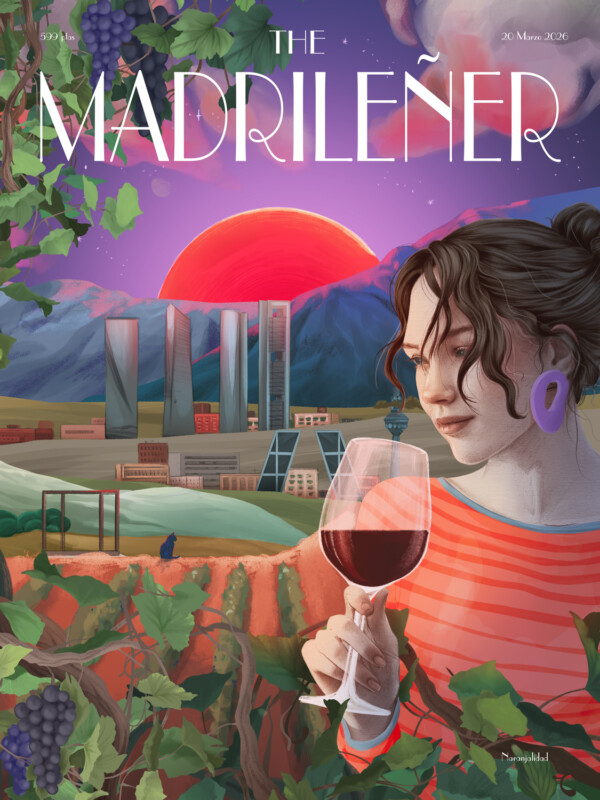
A Toast to Madrid
In the work “A Toast to Madrid”, Beatriz Ramo unfolds her creative universe: a vibrant and electric visual language, where portraiture takes centre stage and is enveloped in natural atmospheres with subtle surrealist touches. The piece was created in collaboration with The Madrilener, a collective project that interprets Madrid as an imaginary magazine inhabited by stories, scenes and characters that shape the city’s contemporary identity. In this context, “A Toast to Madrid” functions as a visual narrative: a scene that could be a magazine cover, but also a lived moment. The composition places us in a sunset suspended in time. Spring, here embodied as a woman and a landscape, bursts forth with light and colour. The protagonist holds a glass of wine in an intimate, almost frozen gesture, just before the toast. Her gaze, intense and reflective, creates a moment of pause that invites us to wonder what emotion or thought inhabits that instant. In the foreground, the vines connect us to the earth, whilst in the background the Sierra de Gredos, the Madrid skyline and the landscapes of the Finca Marañones are symbolically intertwined. A shared landscape that unites origin and city, the rural and the urban, the natural and the human, within a single visual narrative.
About the artist: Beatriz is an illustrator (and former architect) from Alicante who lives in Madrid. Her work is characterised by the almost constant presence of portraiture, enhanced by natural settings, a rich palette of colours and subtle surrealist touches. Her work is primarily defined by the use of pencil, charcoal, watercolour and digital media, although she employs a range of experimental techniques in her pieces. She seeks to transport the viewer into the distinct atmospheres that accompany each piece, through stark, intense expressions and the interplay of all the elements that make up each image.
A journey through art and landscape
Each piece draws its inspiration from the identity of its place of origin. It is our way of recognising local talent and highlighting the connection with those who share a way of understanding the land through knowledge, craftsmanship and respect for the processes involved.
Just as in the vineyard, each work is the result of a unique interpretation. A patient, artisanal process that transforms raw materials into expression and which, just like our wines, finds its meaning in its origins.
Thus, spring after spring, this collection continues to grow alongside us, bearing witness to the fact that art and wine share the same essence: time, sensitivity and a deep connection to the land. A collection that can be appreciated through our wine tourism experiences at Pago de Carraovejas.